
Our community actions
The power of community to transform the cosmetics industry
The power of community to transform the cosmetics industry
Because individual well-being and the health of the planet are collective, interdependent issues—and because we are all links in the chain—we believe in the power of collective action to transform our business models.
To confirm our purpose even more and accelerate our transition, we are working on our broadened ecosystem, by relying on an open innovation process and building new business models together.
We are developing partnerships at local and international level, within coalitions and associations but also with a collection of actors from various areas.
We therefore make community a real advantage at the heart of our considerations, the transition of our sector and that of our company.
Our main cooperative actions
The CEC stems from one desire: to consider and implement solutions able to avoid a conflict between the climate emergency and companies’ economic priorities. We took part in the CEC when it was set up in 2021, alongside 149 other companies, because we believe in the synergy of actions and shared goals.
In concrete terms, this means defining a roadmap together to redesign our models and activities.
It was natural that our Mustela brand set itself a roadmap within the CEC of “bringing parents closer to essential family services”. Today our Mustela brand makes a commitment to future generations, to deeply transform its economic model in depth, and mobilize its value chain up and downstream to take part in improving human well-being and society in general.
Accompanied by consulting firm (RE)SET, and in partnership with the FEBEA (Federation of Beauty Companies), we joined forces with 12 other actors in the cosmetics industry to create the RE(SET) for Cosmetics research and development project.
Our first challenge? Concentrate on the issue of packaging and using plastic coming to an end.
Under the code name “Pulp in Action”, we are exploring new packaging formats based on plant-derived cellulose fibers. Used at industrial scale, they must meet the demands of cosmetic products in terms of quality of use, barrier properties and formula preservation (restitution level, water resistance, formula stability, etc.).
It’s an attractive solution, but one that is not so easy to implement, without putting in serious R&D and pooling research with the partner companies in the program.
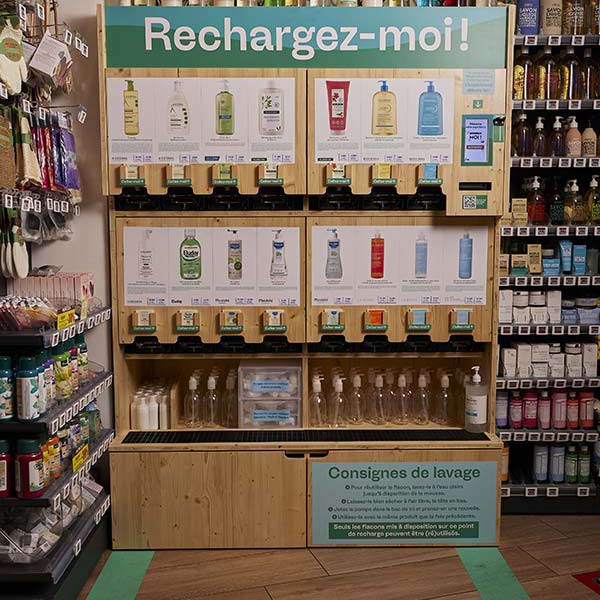
In 2023, we joined forces with 4 other actors in dermo-cosmetics within a consortium to propose for 15 iconic products in a bottle that can be refilled in pharmacies.
The aim? To meet a shared need among consumers, manufacturers, and pharmacies: developing refillable packaging solutions to reduce the amount of packaging used in the cosmetics sector.
Our Mustela brand and the brands A-Derma (Pierre Fabre), Bioderma (NAOS), Ducray (Pierre Fabre), Eluday (Pierre Fabre), Garancia, Klorane (Pierre Fabre), La Rosée decided to unite to provide the consumer with a refill point which has been tested in a Parisian pharmacy first of all: the Pharmacie Carré Opéra at Chaussée d’Antin (Paris 9th arrondissement), before rolling out the experience to other sales outlets. At the end of 2024, Biocodex (Saforelle), Laboratoire SVR, Léa Nature (Natessance, Eaux thermales Jonzac) and Laboratoires Dermatologiques Uriage joined the consortium.
The virtuous approach was created by cooperating with actors in the French re-use ecosystem, with the idea of constructive collaboration and repetition. The consortium brought in experts from the circular economy and was assisted by (RE)SET, the consulting firm dedicated to the environmental transition.
At the initiative of Chanel, TRASCE (TRaceability Alliance for Sustainable CosmEtics) consortium was launched in February 2023 from the need to change the scale of traceability approaches in the cosmetics sector, faced with the multiplication of initiatives that are necessary, but individual.
What are the objectives? To accelerate the transformation of sectors to move towards a more resilient model, consolidate the collective approach to CSR risks and define common progress plans.
This sector-based alliance brought together 15 companies in the cosmetics industry when it was launched, both brands and suppliers: Albéa, Chanel, Clarins, Cosfibel powered by GPA Global, Dior, The Estée Lauder Companies, Groupe Pochet, L'Occitane en Provence, L'Oréal Groupe, Merck, Neyret, Nuxe, Sensient, Shiseido and Sisley.
We became regular members of the consortium In June 2024, along with Groupe Rocher and NAOS.
Through consortium members mapping their supply chains on a common digital platform, Transparency-One (an ISN company), TRASCE puts the strength of working collectively at the service of the sector as a whole.
The FEBEA (Federation of Beauty Companies) also supports this industrial initiative as an official sponsor.
Under the initiation of Cosmetic Valley, the Beauty Hub came into being in 2020, from 9 actors in the sector joining forces. Today its consortium has 12 companies plus Expanscience!
The aim of creating this ecosystem is to promote innovation, around 2 major programs:
We are members of the steering committee and play an active part in developing these 2 programs.
As you will have realized, we are convinced that uniting our strengths will enable us to transform the cosmetics industry!
top of page